
by Dr. John McKeon, medical director at Airmid and expert author on aerobiology, infections aerosols and indoor air. Dr McKeon is an Ambassador of the World Filtration Institute, an accredited educator for the American Institute of Architects and a member of the Environmental Health Committee of ASHRAE.
A recent spotlight on ultrafine particle emissions — including a major New York Times article — has reignited concerns about indoor air quality and the role of everyday appliances. While vacuum cleaners were the initial focus, growing evidence suggests that the impact of air conditioners, air cleaners, and dehumidifiers may be even greater.
At Airmid Healthgroup, we have found that operating air conditioners — especially portable and through-the-window units — can result in significantly higher exposure to bacterial fragments and other airborne micro-organisms than some vacuum cleaners. Given that these appliances often lack sophisticated filtration, this finding, while concerning, should not be surprising.
Understanding the Risk
Indoor dust contains bacteria, viruses, mold spores, and toxic particles, many of which are sub-micron in size. Once airborne, these ultrafine particles can remain suspended for days, easily recirculated by air-moving appliances. Compounding the problem, microbial growth inside the appliances themselves — including molds and bacteria — can further amplify particle release.
This cycle of contamination poses serious risks for human health, increasing exposure to potentially infectious or allergenic particles every time these devices operate.
Aerobiology testing
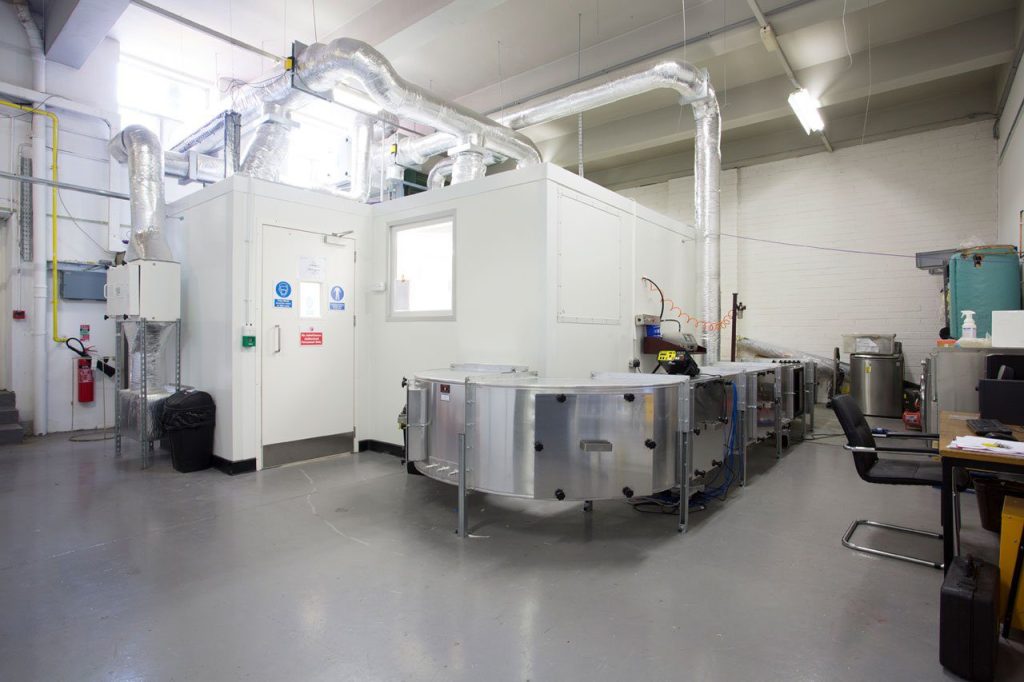
At Airmid Healthgroup, we are uniquely positioned to address these challenges. Our state-of-the-art aerobiology chambers allows us to track airborne pathogens and ultrafine particles under controlled conditions using advanced molecular biology, air sampling, and particle counting technologies. This approach delivers far greater sensitivity and specificity than traditional culture-based methods.
Our testing not only quantifies airborne biological contaminants but also measures an appliance’s ability to capture and retain harmful particles — critical data for manufacturers focused on product performance and consumer safety.
Why It Matters
Forward-thinking companies that proactively address these hidden air quality risks can position themselves as leaders in health-focused innovation. As consumers become increasingly aware of the links between indoor air quality and well-being, “Health in the Home” is fast becoming a critical purchasing factor.
Our advice for manufacturers:
- Quantify emissions and contamination risks across a wide range of electrical appliances
- Innovate with next-generation filtration and decontamination technologies
- Validate health claims with robust, third-party data to drive product differentiation and brand trust
Join Us in Shaping the Future of Healthy Indoor Environments
If you would like to learn more about how we can support your product development, compliance, or marketing initiatives, please contact us
Written by Dr John McKeon; subject matter expert and author for Airmid Healthgroup’s thought leadership blog due to his extensive expertise in medicine, entrepreneurship, and indoor air quality innovation. His diverse background and thought leadership make him an invaluable contributor to advancing health-focused conversations within the indoor environment sector
Further Reading
- Knibbs LD, He C, Duchaine C, Morawska L. (2012). Vacuum cleaner emissions as a source of indoor exposure to airborne particles and bacteria. Environmental Science & Technology, 46(1):534–42.
- Kreyling WG, Semmler-Behnke M, Möller W. (2006). “Ultrafine particle–lung interactions: does size matter?”. Journal of Aerosol Medicine, 19(1):74–83. DOI:10.1089/jam.2006.19.74
- EPA. The Inside Story: A Guide to Indoor Air Quality
- Geiser M, et al. (2005). “Ultrafine particles cross cellular membranes by nonphagocytic mechanisms in lungs and in cultured cells”. Environmental Health Perspectives, 113(11):1555–1560. DOI:10.1289/ehp.8006
- Science Daily (2008). “How Ultrafine Particles in Air Pollution May Cause Heart Disease”
Related Services at Airmid Healthgroup
We offer a comprehensive portfolio of aerobiology and indoor air quality testing services that support clients from R&D to market launch:
Custom Appliance Emissions Testing (e.g., AC units, air purifiers, dehumidifiers)
Bioaerosol Quantification using qPCR, impaction sampling, and optical particle counting
Independent Claims Validation for marketing, regulatory, and investor communications
Related Case Studies
- Air Sniper’s Germicidal UVGI Technology – Advancing Indoor Air Quality
This case study details how Air Sniper collaborated with Airmid Healthgroup to validate the performance of their UVGI systems in eliminating airborne pathogens. The study provides scientific evidence supporting the efficacy of UVGI technology in improving indoor air quality. - Chem-Dry’s Cleaning Process Validated for Allergen and Bacteria Removal
Airmid Healthgroup validated Chem-Dry’s cleaning process, demonstrating a 98% removal of allergens and an 89% reduction in airborne bacteria. This case study highlights the impact of effective cleaning processes on indoor air quality.
Related Airmid Blogs
Call for Abstracts for the International Ultraviolet Association (IUVA) 2025 World Congress
An Overview of the ASHRAE 185 Series: Standards for Evaluating Air-Cleaning Technologies ISO 15714:2019 – What You Need to Know About Bioaerosol Efficacy Testing for Air Teatment Devices
Helpful Key word phrases
Air conditioner emissions testing, aerobiology chamber testing services, indoor air quality product validation, bioaerosol sampling and analysis, filter performance against airborne pathogens, air purifier claims validation, ultrafine particle exposure assessment, GLP-certified microbiology testing lab, independent health impact testing, ISO 17025 indoor air testing laboratory.
About the Author
Dr. John McKeon is a trusted subject matter expert for Airmid Healthgroup’s thought leadership blog. He has extensive expertise and contributions in the fields of medicine, entrepreneurship, and indoor air quality. He is a recognized leader in the field, participating in various industry committees related to health and indoor air quality. His work emphasizes the importance of interdisciplinary collaboration and people-centric design in transforming indoor environments. Dr. McKeon’s diverse experiences and insights make him an invaluable contributor to discussions aimed at improving health outcomes through better indoor environments.
About Airmid
Airmid Healthgroup is the global leader in bioaerosol science, helping innovators turn biomedical insights into market-ready product claims.
We work with companies across medtech, consumer health, HVAC, and home appliances to quantify health impacts, validate product performance, and unlock new value propositions rooted in air quality and exposure science. From early-stage R&D through to regulatory approval and product marketing, we act as a trusted scientific partner — and an extension of your internal research capabilities.
At the heart of our operation is a uniquely integrated facility combining molecular biology, high-resolution air sampling, and controlled environmental chambers, including multiple Aerobiology Chambers, enabling precision quantification studies of viruses, bacteria, molds, allergens, and ultrafine particles.
Our clients rely on us for more than just data — they come to Airmid for independent, defensible evidence that turns complex science into commercial advantage.
Are you a medtech innovator looking to enhance the safety and performance of your products?
Contact the Airmid Health Group team today to learn more about the independent testing process and how it can enhance your product’s credibility in the market.


