
By Dr. John McKeon, iAIR Institute / Airmid Healthgroup
I had the privilege of attending the Greenbuild 2025 Summit: Healthy Spaces for All in Los Angeles — an event that brought together global leaders across health science, building design, real estate, and public-sector innovation. The focus was clear: the built environment is now entering a new era, one where healthy building practice must evolve from high-potential pilot concepts to fully scaled, evidence-driven implementation.
Setting the Tone: The Scaling Era Has Arrived
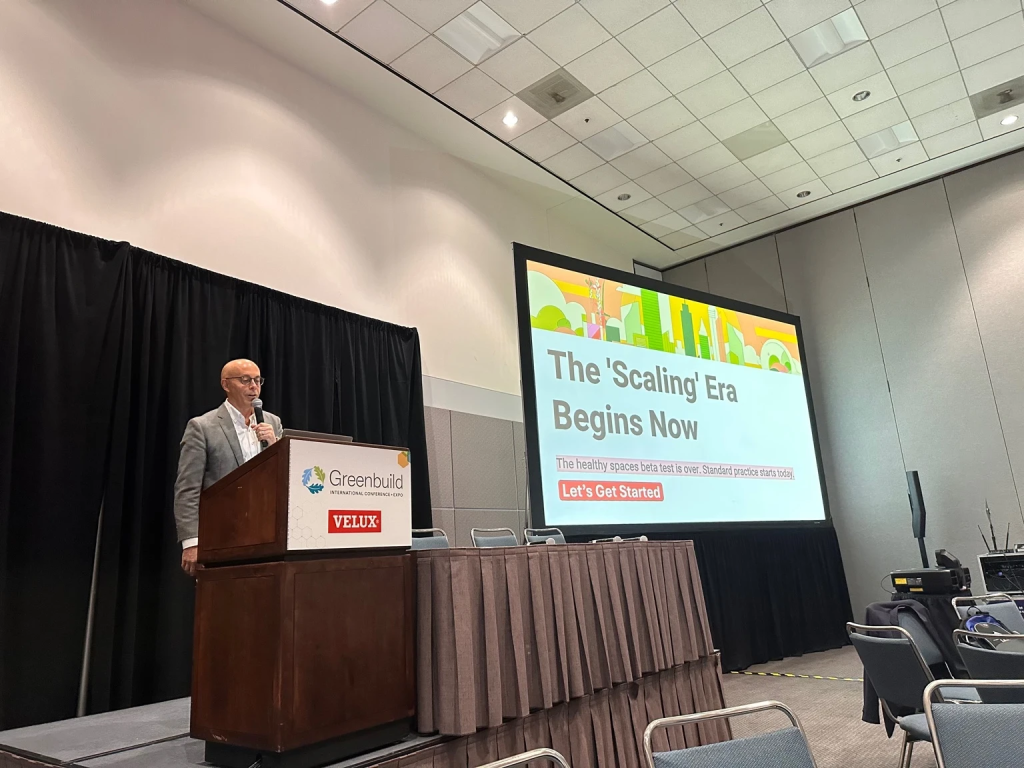
A highlight of the day was hearing Dr. Matthew Trowbridge underscore a pivotal shift in the healthy-building movement. As he put it, “the time for scaling healthy buildings is now.”
Dr. Trowbridge opened the summit by charting the evolution of the field over the past 15 years, from establishing the foundational links between building performance and health outcomes, to developing early frameworks for implementation. Today, he argued, we stand at a critical inflection point: the science is mature, the need is urgent, and healthy spaces must move from aspiration to standard practice.
This theme aligned strongly with what we see at Airmid Healthgroup: the beta phase is over. The industry now needs scalable, verified, repeatable, and measurable healthy-building strategies.
Engaging with ASHRAE Leadership
I was delighted to join the workshop table with William McQuade, President of ASHRAE, whose leadership continues to shape the global standards landscape for IEQ and indoor environmental systems. His presence brought rigour and clarity to the discussions, reinforcing the essential role of performance standards, continuous monitoring, and evidence-based design in the next generation of healthy buildings.
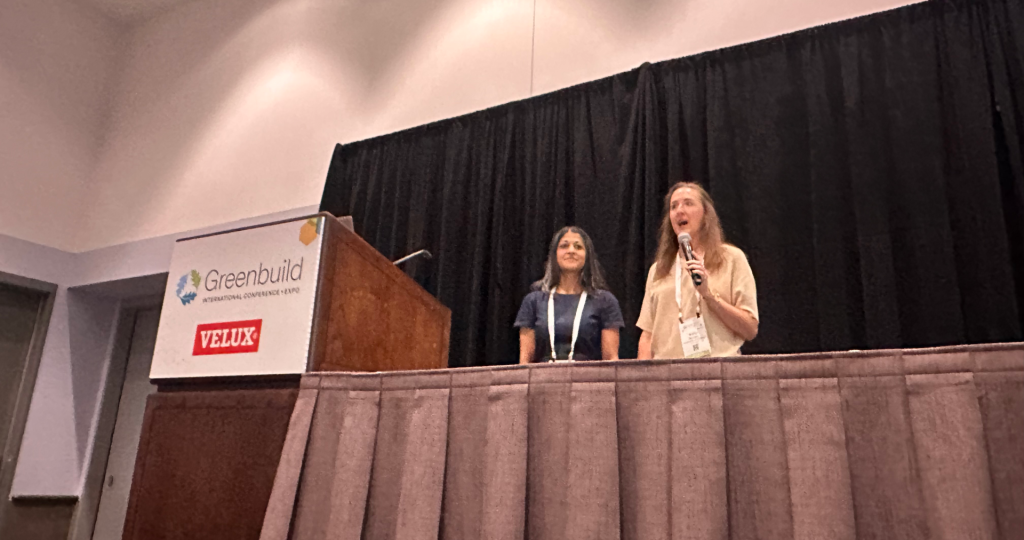
Leadership from USGBC & IWBI: Seema Bhangar and Kelly Worden
It was also a pleasure to reconnect with Seema Bhangar, Principal for Healthy Buildings and Communities at the U.S. Green Building Council (USGBC). Seema brings an exceptional multidisciplinary perspective to the sector.
She is a visiting scholar at UC Berkeley’s College of Environmental Design Research and a Director at the Indoor Air Institute, and previously served as:
- Indoor air quality program manager at WeWork
- Product manager at Aclima, a pioneering environmental-sensing company
- Contributor to advisory committees for ASHRAE, the National Academies of Sciences, Engineering, and Medicine, IWBI, Johns Hopkins Center for Health Security, and the U.S. General Services Administration
Her systems-level viewpoint — connecting building science, technology, policy, and real estate — added depth and relevance across the summit.
Alongside her, one of the day’s conveners was Kelly Worden, a sustainability and public-health practitioner with over a decade of experience helping real estate investors and developers integrate long-term value creation through environmental and social performance. Kelly leads social sustainability at the International WELL Building Institute, where she plays a central role in shaping and advancing the WELL Standard for healthier buildings and organisations. Her contributions grounded the day in evidence-based, human-centred design.
Key Themes from the Summit
1. From Pilots to Scale: Health as Standard Practice
Greenbuild made it clear that healthy-building strategies can no longer be confined to niche pilots or premium projects. The next decade must focus on scaling — through standardisation, governance, and rigorous verification.
2. Inclusive Design as a Core Requirement
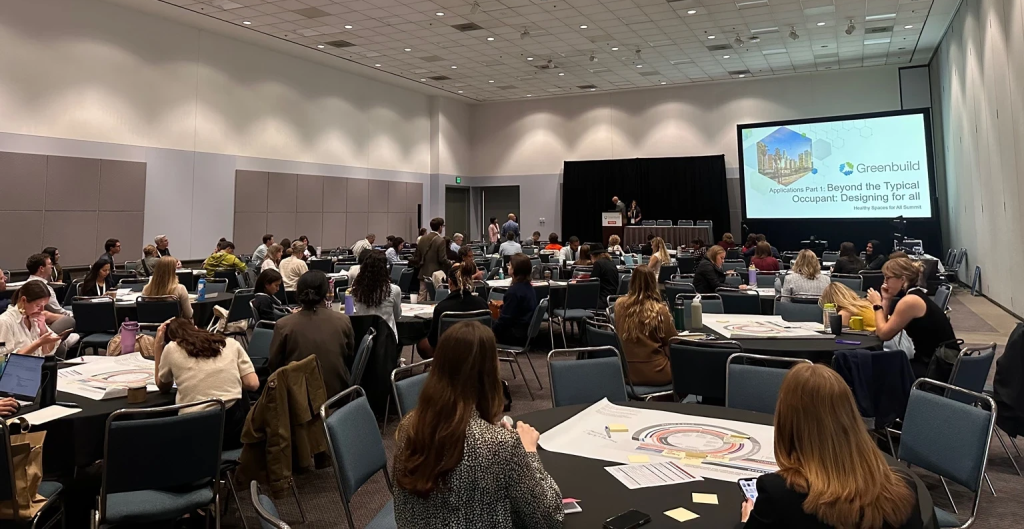
A recurring theme was designing beyond the typical occupant. Buildings must work for people of different ages, abilities, health statuses, and lived experiences. Inclusive, trauma-informed, and biophilic design principles were highlighted as essential, not optional.
(Insert Image: Full Room – “Designing for All” Session)
3. Lifecycle Thinking and Community Health
Healthy spaces now extend far beyond building interiors. Material toxicity, energy sourcing, supply-chain impacts, and community exposures are increasingly central to assessments of building performance.
4. Clear Metrics and ROI for Decision-Makers
As echoed by William McQuade, the industry needs to communicate healthy-building value in business terms:
- KPIs
- Performance data
- Operational savings
- Employee wellbeing and retention
- Risk reduction and resilience metrics
How Airmid Healthgroup and the iAIR Institute Support This Shift
Our combined ecosystem — a GLP/ISO-accredited aerobiology laboratory, paired with a healthy buildings think-tank and academy — positions us uniquely to support organisations seeking to lead in this space.
We provide:
- Airborne pathogen and aerosol performance validation
- Antimicrobial materials and surface testing
- Healthy buildings system verification (air cleaners, HVAC, filtration)
- Applied research and advisory services
- Training and capacity-building for architects, engineers, and developers
As Matthew Trowbridge noted, the scaling era has begun — and Airmid is committed to helping partners implement healthy building strategies with scientific integrity and real-world performance.
Related Case Studies
- Dyson: Independent Validation of Air Purification Performance
- Fellowes AeraMax®: Proven Performance for Cleaner Indoor Air
- Beko HygieneShield™: 99.9% Bacteria & Virus Reduction Validated by Airmid
Related Services
- Air Cleaner & Purification Performance Testing
- Aerobiology & Chamber Testing for Airborne Pathogens
- Antimicrobial Surface & Material Performance Testing


