
Measuring What Matters: Aerobiology and Indoor Environmental Quality Testing
How controlled laboratory testing underpins healthier indoor environments
by Dr. John McKeon, Medical director at Airmid and expert author on Aerobiology, infections aerosols and indoor air. Dr McKeon is an Ambassador of the World Filtration Institute, an accredited educator for the American Institute of Architects and a member of the Environmental Health Committee of ASHRAE.
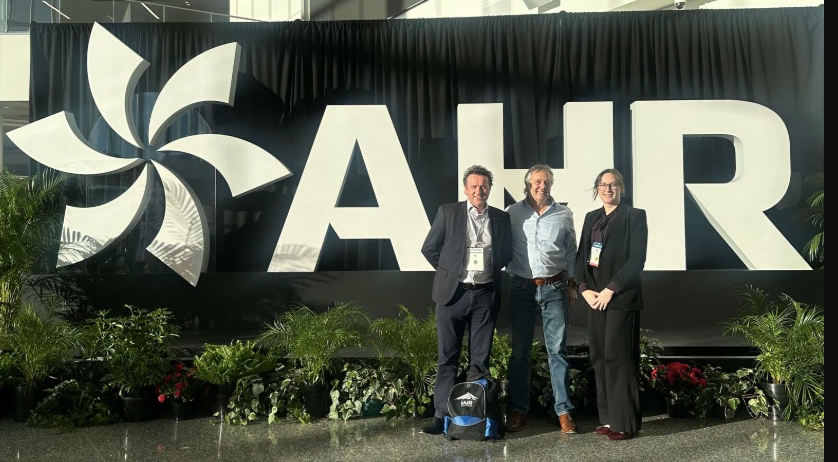
Major industry forums such as The International Surface Event, the ASHRAE Winter Conference, and the AHR Expo showcase innovation in materials, ventilation systems, and building technologies. For iAIR Labs, however, the defining question at these events is ‘what is measured?’
Dr John McKeon’s active role across multiple ASHRAE committees, including ventilation standards, infectious aerosol control, and environmental health, reflects this same priority: ensuring that evolving standards are grounded in reproducible laboratory evidence rather than theoretical equivalency alone.
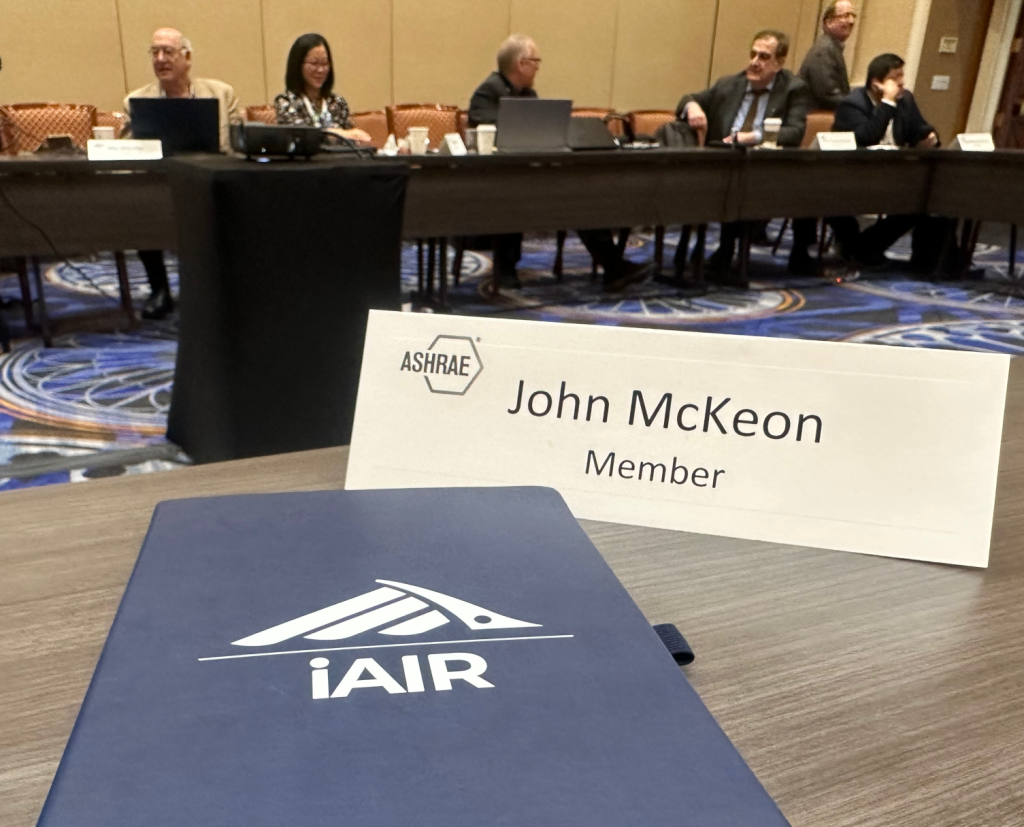
Advancing indoor environmental quality testing (IEQ) is fundamentally a scientific challenge. It requires controlled environments, defined variables, reproducible methodologies, and biological relevance. Without this foundation, performance claims cannot be meaningfully interpreted or compared.
Materials, Emissions, and Surface Reservoirs: Testing Exposure at Source
Discussions across flooring and textile sectors increasingly acknowledge that materials influence indoor exposure dynamics. These discussions were very much in evidence at TISE and at the Las Vegas Winter Market. From a laboratory perspective, this translates into measurable endpoints:
- VOC emission rates under controlled temperature and humidity
- Allergen retention, reduction, and re-release potential
- Microbial survival and proliferation
- Particle resuspension under defined disturbance
Environmental chamber testing allows for isolation of variables and accurate quantification of emissions and biological burden. Flooring and soft furnishings act as both reservoirs and secondary sources. Evaluating them requires integrated chemical analysis and aerobiological modelling, definitely not assumptions.
For indoor environmental quality testing the scientific objective is clear: determine what is emitted, what persists, and what becomes airborne under realistic but controlled conditions.
Human-Centered IEQ: Biological Parameters in Controlled Environments
At ASHRAE, research discussions (including the seminar by Pawel Wargocki, “Human-Centered IEQ: Advancing Health and Performance in Modern Spaces” ) emphasized the role of humidity in cognitive function, health outcomes, and sleep quality.
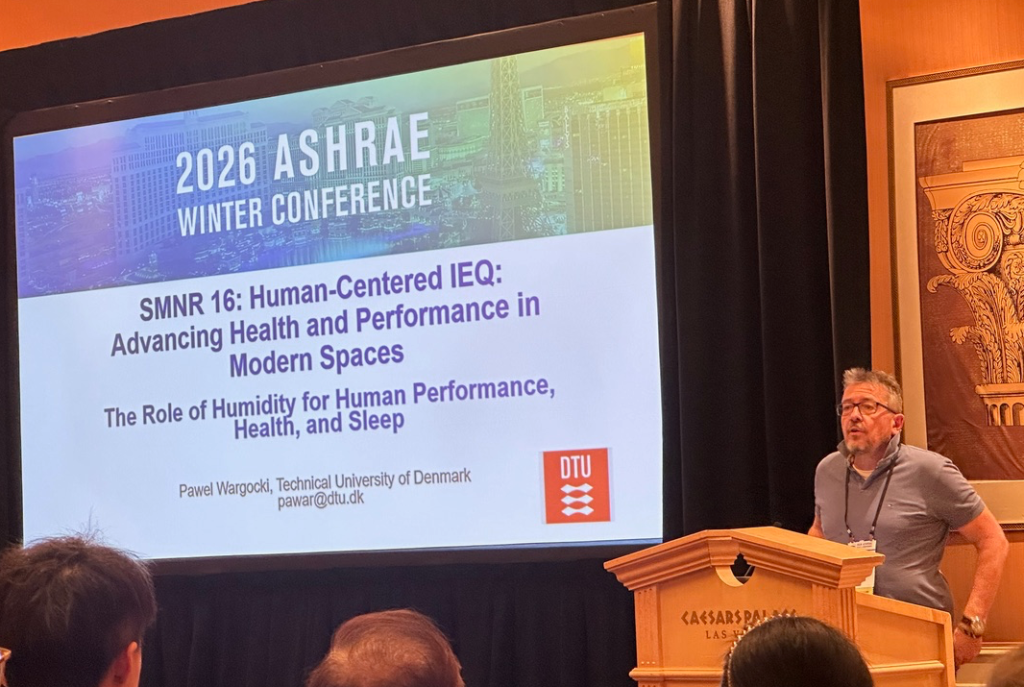
From an aerobiology standpoint, humidity is not a comfort variable alone; it is a biological determinant affecting:
- Allergen viability
- Fungal growth
- Viral persistence
- Aerosol stability
- Chemical emission profiles
Environmental chambers enable precise modulation of humidity to assess its interaction with both chemical and biological contaminants. This is where physiological insight must align with controlled testing to generate reliable performance data.
Standards Require Validated Methods
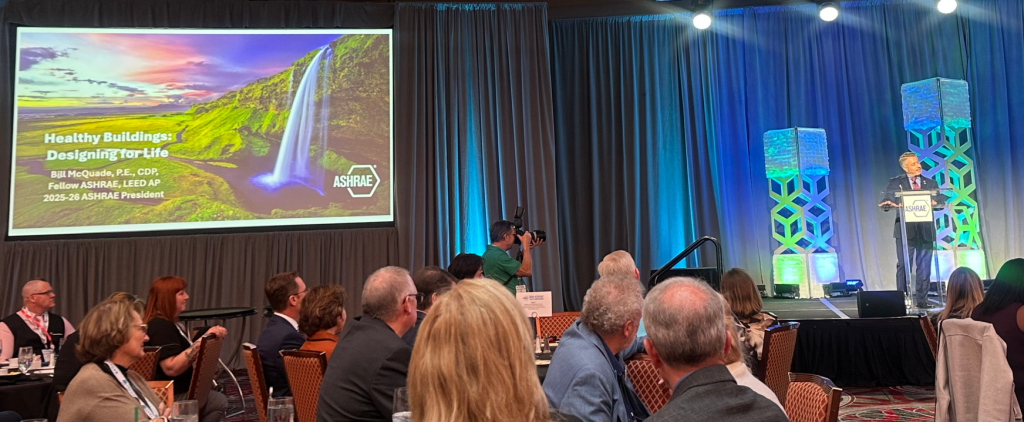
Leadership themes advanced at ASHRAE, including those articulated by William McQuade, reinforce the need to integrate health outcomes into building performance frameworks. That integration depends on robust and trusted test methodologies.
Through participation in committees such as SSPC 62.1 and 62.2 (ventilation), SSPC 241 (control of infectious aerosols), and related environmental health task groups, Dr McKeon contributed technical insight drawn directly from aerobiological testing and environmental chamber research to inform how performance thresholds are defined and evaluated.
Ventilation standards, infectious aerosol control measures, filtration equivalency debates, and reactive air treatment technologies all require:
- Defined challenge aerosols
- Controlled airflow conditions
- Quantifiable reduction metrics
- Repeatable laboratory protocols
Performance validation is procedural and precise. Aerobiological test chambers, bioaerosol generation systems, and calibrated analytical equipment are essential to establishing defensible benchmarks.
Infectious Aerosols and HVAC Performance Validation
Ongoing focus on aerosol transmission and air cleaning technologies reflects a shift toward measurable risk mitigation. Engagements across industry and organizations such as the National Air Duct Cleaners Association highlight the importance of maintenance, airflow optimization, and system hygiene.
Claims of microbial reduction or ventilation equivalency must be supported by data generated under controlled and transparent conditions.
Whole-System Indoor Environmental Quality Testing for Whole-Building Outcomes
Healthy buildings cannot be validated through isolated component testing alone. Indoor environments are complex biological-physical systems requiring integrated assessment of:
- Surface interactions
- Airflow dynamics
- Microbial ecology
- Chemical emissions
- Human exposure pathways
Laboratory protocols must replicate interaction effects where possible, rather than evaluate components in artificial isolation. Environmental chambers provide the infrastructure to simulate real-world conditions while maintaining scientific control.
The Future for Indoor Environmental Quality Testing
Across materials, ventilation, and air treatment technologies, performance must be demonstrated, not asserted. For iAIR Labs, the mandate remains precise: design and execute testing that quantifies real-world exposure dynamics under controlled laboratory conditions.
Aerobiology, environmental chamber science, and rigorous validation are foundational to indoor environmental quality, and the next phase of healthy buildings will not be defined by innovation alone, but by measurement.
Related Tests and Services at Airmid Healthgroup
Independent Performance Testing of Furnace Filters and HVAC Systems
Purpose-Built Bioaerosol Chambers for Infectious Aerosols & Airborne Pathogen Testing
Independent ASHRAE 241 Standard Test for Bioaerosols and Air Cleaning Technologies
Related Blogs
ASHRAE Distinguished Lecturer Professor Chandra Sekhar Visits Dublin for Seminar on Standard 241
A Special Workshop: Toward an ASHRAE Standard on IEQ
Airmid Healthgroup Medical Doctor Elected Vice President of ASHRAE Ireland


