
Resource article: From Sustainability to Human Health: A Shift in Cleaning Product Innovation
International Cleaning Week and Cleaning Products Europe 2026
International Cleaning Week is a useful point in the year to look at how the cleaning products sector is changing. For a long time, the main focus has been on sustainability. Reducing environmental impact and improving biodegradability have shaped product development.
Of course, this is still important. But there is now more attention is focussing on how cleaning products affect people, particularly through indoor air quality. This is reflected at Cleaning Products Europe 2026 in Amsterdam this week. Alongside sustainability, circularity and regulation, there is increasing discussion around the link between cleaning products and indoor air quality and how this impacts human health.
Not Just Sustainable
A product can be environmentally sustainable, but that does not mean it is neutral from a human health perspective. Labels such as “natural”, “green”, or “fragrance-free” do not always indicate how a product performs in use, and are often used loosely. Some products can release chemicals into the air or contain ingredients that may irritate sensitive individuals.
As buildings become more airtight and as consumer demand for ‘healthier’ products increases, this matters more. There is a growing focus on:
- what is released into the air during use
- how the ingredients impact indoor air quality
- whether allergens are removed or simply moved around
- how products impact human health
Fragrance, Cleaning Products and Indoor Air Quality
Fragrance is a good example. Many people associate a scent with cleanliness, but exposure to certain fragrance compounds can cause issues for some individuals. Research carried out by Airmid scientists, published in The Journal of Allergy and Clinical Immunology, looked at whether more suitable fragranced cleaning products are possible.
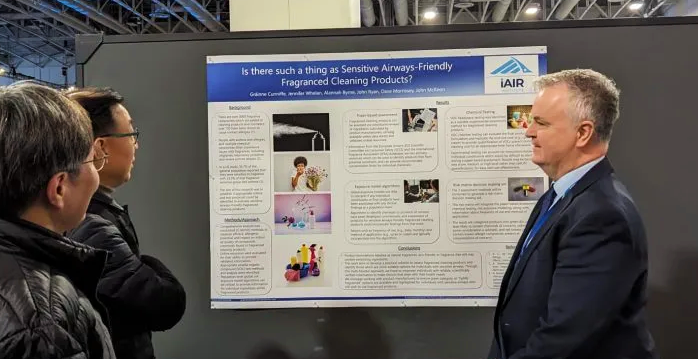
The findings show that it is not straightforward. Even products described as natural or eco-friendly can contain sensitising ingredients. Identifying more suitable formulations depends on careful ingredient review, reliable safety data, and an understanding of how people are exposed to these compounds in practice.
This is something also being explored at Cleaning Products Europe, including a pre-conference workshop on fragrance formulation, claims, and testing, reflecting the increasing need to align product performance with safety and real-world use.
A Complete View of Cleaning Products and Indoor Air Quality
Cleaning deals with what is removed from surfaces, but it also has an impact on what ends up in the air. Effective products should:
- effectively clean surfaces
- avoid increasing airborne particles during use
- limit unnecessary chemical emissions
This requires a closer link between formulation, indoor air science, and how products are actually used day to day.
The Future
Innovation in this space is becoming more balanced. Environmental performance remains important, but it is being considered alongside human exposure indoors. There is also more emphasis on how products are tested, with growing interest in methods that reflect real-world use and provide clear, measurable outcomes.
International Cleaning Week is a reminder of the link between cleaning products and indoor air quality and how cleaning products are designed, tested, and evaluated in the years ahead.
Related Tests and Services at Airmid
Cleaning Product Efficacy & Biomedical Testing Services
BS EN 1276:2009 The evaluation of bactericidal activity of chemical disinfectants and antiseptics
AATCC 100 Fabric Testing and Claim Verification
BS EN 13610:2002- Virucidal Claim Verification
Related Blogs and Case Studies
iAIR Labs Validates the Allergen and Bacteria Removal Efficiency of Chem-Dry
Certified Free & Simple Hardwood Floor Cleaner by Bona Proven Effective by Airmid Healthgroup
Verified Healthier Air in Practice: The DELPHIN T8 at Haus Hubertus

