
By Dr. John McKeon, Medical Director at Airmid Healthgroup and expert author on aerobiology, infectious aerosols, and indoor air quality. Dr. McKeon is an Ambassador of the World Filtration Institute, an accredited educator for the American Institute of Architects, and a member of the Environmental Health Committee of ASHRAE.
Vacuum Cleaner Emissions Testing: What Air-Moving Appliances Are Releasing Indoors
A study from Australia, reported by The New York Times, reignited concerns about vacuum cleaner emissions — specifically ultrafine particle pollution from devices that use HEPA filters. Independent emissions testing has shown that vacuums may be just the tip of the iceberg.
At Airmid Healthgroup, we’ve uncovered evidence that other common appliances — including portable air conditioners and dehumidifiers — may emit even greater quantities of ultrafine particles and airborne biological contaminants. These tiny particles, often smaller than 0.1 microns, can carry bacteria, mould fragments, and toxins, staying airborne for extended periods and potentially affecting human health.
Ultrafine Particles: What’s Lurking in Your Indoor Air?
Household dust is more than a nuisance — it’s a complex mixture that can include viruses, bacteria, mould spores, allergens, and toxic particles. When disturbed, these particles become airborne and can remain suspended for days.
What’s more concerning is that many air-moving devices are poorly filtered, if filtered at all. Initial Airmid data shows that portable and window-mounted air conditioning units can emit up to ten times the amount of biological fragments as standard vacuum cleaners. These particles are easily inhaled and have been linked to respiratory conditions, allergic reactions, and even cardiovascular effects.
The Role of Airmid Healthgroup in Solving This Challenge
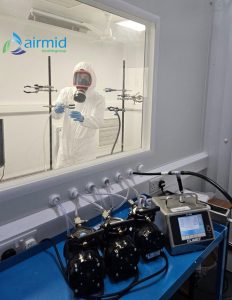
At Airmid Healthgroup, we operate one of the world’s most advanced integrated environmental testing facilities. Our AC-1 environmental test chamber combines molecular biology, aerobiology, and advanced particle counting to accurately track how infectious agents behave in indoor air — and how appliances can influence their spread.
We use these capabilities to:
- Quantify airborne exposure from household appliances
- Analyse residual contamination within devices
- Develop solutions to reduce airborne biological pollution
- Provide manufacturers with actionable data to support product innovation and claims
This scientific approach offers far more sensitivity and specificity than traditional culture-based methods. It’s part of our commitment to help companies proactively improve product performance and consumer trust.
Innovation Opportunity for Manufacturers
Forward-thinking companies can turn this challenge into an opportunity. By identifying and mitigating ultrafine particle emissions, brands can gain competitive advantage and meet rising consumer demand for healthier indoor environments.
With growing awareness around indoor air quality, the spotlight will inevitably widen from vacuums to other appliances — air conditioners, dehumidifiers, and air purifiers. Now is the time for innovation, transparency, and third-party validation.
If you’re a product developer, compliance officer, or brand manager concerned about airborne emissions from your appliances, we invite you to partner with us. Let’s develop cleaner, safer indoor technologies together.
Related Services at Airmid Healthgroup
- Independent Validation for Vacuum Cleaner Innovation
- Vacuum Cleaner Microbial Pick-Up Test
- Vacuum Cleaner Allergen Removal with ELISA Analysis
- Furnace Filters and HVAC Systems Testing
- Room Air Cleaner Testing
Related Blogs from Airmid Healthgroup
- Swiss Precision Meets Irish Innovation: Airmid Healthgroup Welcomes Swissatest Testmaterialien AG for Strategic Visit
- DELPHIN T8 Achieves Verified Healthier Air Mark: A Higher Standard in Indoor Air Quality
- Particle Size Distribution in Domestic House Dust: ISO Fine Test Dust vs Real House Dust
- Independent HVAC Filtration Testing
Related Case Studies
- Reduction of Allergen Levels in Carpets in US Homes Using Hot Water Extraction Cleaning
- Airmid Validates Fellowes® AeraMax™ Air Purifiers for Removing Cold and Flu Viruses
Do you want to validate your technology?
Contact the Airmid Healthgroup team today to learn more about the independent testing process and how it can enhance your product’s credibility in the market.


