
by Dr. John McKeon
The ASHRAE Winter Meeting was a whirlwind of activity—intense discussions, committee meetings, and thought-provoking sessions. ASHRAE 241 was a key topic! As always, it was great to be part of such a dynamic gathering of experts shaping the future of indoor air quality, infectious aerosol control, and building health.
 L-R: Josephine Lau, Max Sherman, William Bahnfleth, Marwa Zaatari, Travis English
A Deep Dive into ASHRAE’s Position on Infectious Aerosols and Standard 241
As part of my preparation for the ASHRAE Winter Meeting (which meant plenty of pre-reading and tackling the infamous ASHRAE MBOs!), I took a deep dive into two critical documents:
- ASHRAE’s Position Document on Infectious Aerosols – outlining the society’s stance on airborne disease transmission and the role of HVAC in mitigating risks.
- ASHRAE Standard 241-2023: Control of Infectious Aerosols – a landmark standard that provides guidance on ventilation, filtration, and air cleaning strategies.
Notably, Standard 241 recently entered public review, marking an important milestone in its evolution. Congratulations to Bill Bahnfleth, Chair of the 241 Committee, and the entire team for getting it to this stage!
To quote directly from it:
“The purpose of this standard is to establish minimum requirements for control of infectious aerosols to reduce risk of disease transmission in the occupiable space in new buildings, existing buildings, and major renovations to existing buildings, including requirements for both outdoor air system and air cleaning system design, installation, commissioning, operation, and maintenance. This standard defines the amount of equivalent clean airflow necessary to substantially reduce the risk of disease transmission during infection risk management mode (IRMM).”
Full standard can be seen here: https://osr.ashrae.org/Online-Comment-Database/ShowDoc2/Table/DocumentAttachments/FileName/4489-BSR-ASHRAE%20Standard%20241P%20TPS.pdf/download/false
As mentioned I also reviewed again, while traveling to the conference, the ASHRAE statement on the control of infectious diseases. This is an excellent “white paper” and will be required to be updated as it officially expires in October of later this year
Here is a paragraph by way of example and other key excerpts:
Why ASHRAE Takes Positions on Infectious Aerosols
ASHRAE consensus standards and other guidance provide the technical foundation for international building practices and energy codes that balance the need for energy efficiency with the need to keep the indoor environment healthy and comfortable for occupants. The design, installation, and operation of buildings’ mechanical systems can improve—or impede—the buildings’ ability to mitigate risk from infectious aerosols.Consequently, ASHRAE’s positions, standards, and design guidance can help avoid health risks associated with infectious aerosols.
ASHRAE Takes the Positions That:
- Exposure to infectious aerosols is an important factor in the transmission of infections in indoor environments between a source and a susceptible individual.
- Engineering controls demonstrated to reduce the risk of exposure to infectious aerosols include dilution with outdoor air provided by mechanical or natural ventilation, filtration of indoor air, indoor airflow patterns, and disinfection by germicidal ultraviolet light and other
- technologies proven to be effective and safe.
- Strategies using engineering controls for managing the risk from infectious aerosols should
- focus on reducing exposure to infectious aerosols in the breathing zone.
- Effective design, installation, maintenance, and operation of ventilation controls are critical to
- achieving needed risk mitigation.
- Existing evidence for the effects of temperature and humidity on infection risk does not justify
- changes to ventilation and IAQ standards, regulations, and guidelines at this time.
- The effectiveness of any one risk mitigation strategy depends on many factors. Using multiple risk mitigation strategies will usually be more effective than reliance on any single strategy.
- Risk mitigation measures should be adaptable to levels of risk in a particular space.
- Combinations of engineering controls and non-engineering controls can be optimized for effectiveness, cost, and energy use.
I particularly think the paragraph on the Mechanisms of Transmission of Infectious Aerosols is very strong and clears up some myths and covers new key terms that were clarified as a result of the pandemic.
An infectious aerosol is a collection of pathogen-laden particles in the air. Typically, infectious aerosols are released by an infected person as part of respiratory activities such as breathing, talking, singing, coughing, and sneezing. All people, whether infected or not, release droplets of respiratory fluid (mucus, sputum, or saliva) spanning a wide range of sizes during such respiratory activities. Some droplets are so large that they cannot remain suspended for more than a few seconds in the expired jet. Some droplets are small enough to be considered aerosol particles (aerosols) that can remain suspended in the air for an extended period. Under all but the most humid conditions, the smallest droplets rapidly evaporate, leaving behind solid or semisolid residue consisting of nonvolatile components of the respiratory fluid. If a person is infected, their respiratory droplets and aerosols may carry pathogens and may be infectious.
Traditional definitions of “airborne” and “droplet” transmission have been shown to be misleading, and revised definitions of transmission routes are more closely aligned with the actual mechanisms by which pathogens are transferred from one person to another (Marr and Tang 2021). These revised routes are (1) inhalation of aerosols, (2) spray of large droplets, and (3) touching a contaminated surface. The first supplants the traditional airborne route, which was assumed to apply only at long distance, while the second and third correspond to the traditional droplet and fomite (or contact) routes. To facilitate readability and understanding, this committee agreed to leverage recently proposed terminology.
You can read the full ASHRAE position document on infectious aerosols here.
Key Takeaways from the ASHRAE Winter Meeting
The meeting reinforced that infectious aerosol transmission and energy-efficient HVAC system operation remain central topics for the built environment. Conversations and scientific debate around healthy buildings, energy efficiency, and public health are more relevant than ever, and ASHRAE continues to play a crucial role in setting the direction.
One of the standout sessions was ASHRAE Session 47, chaired by Dr. Maarwa Zaatari, who also chairs the Environmental Health Committee, which tackled myth-busting in health and well-being—a fascinating discussion that cut through misinformation and highlighted evidence-based best practices.
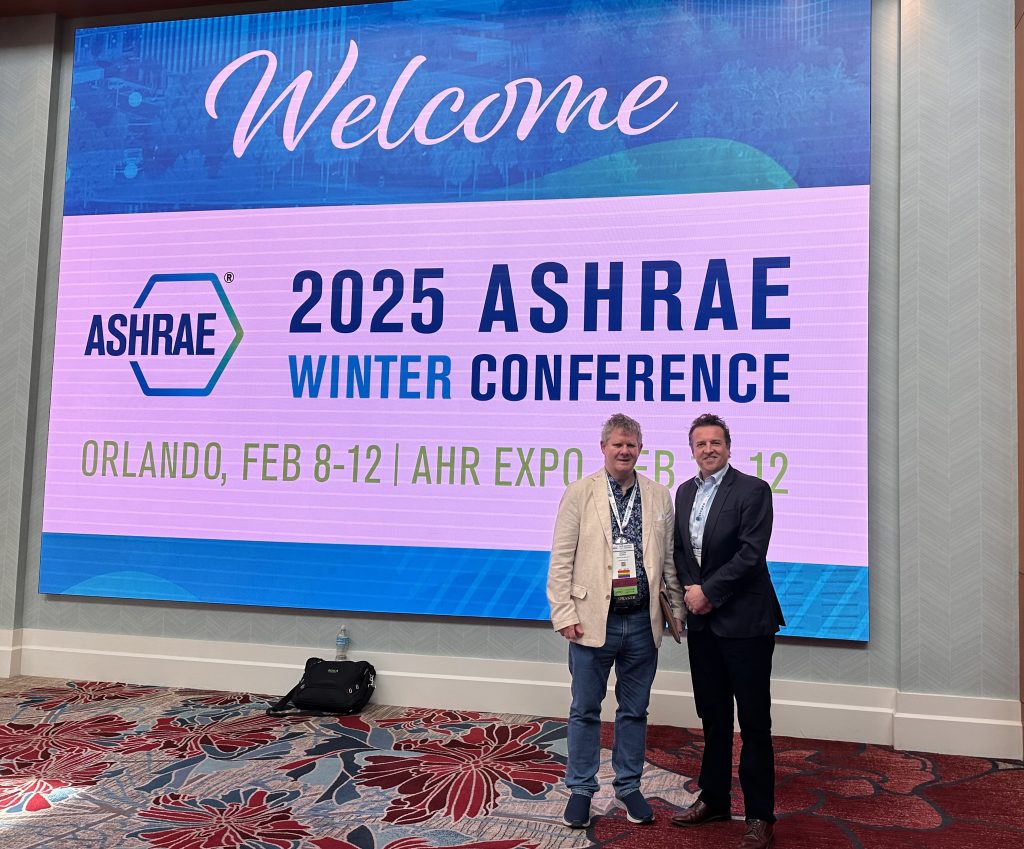 L-R: Conor Murray, Dr John McKeon
Looking Ahead
As part of the Environmental Health Committee (EHC), SPC 185.5, and TG2.RAST, I’m excited to continue contributing to ASHRAE’s ongoing efforts in this space.
The work being done today will shape the buildings of tomorrow; “healthier”, more resilient, and more sustainable, to help healthy people live on a healthy planet.
If you’re working in this field, now is the time to stay engaged. With Standard 241 under review and ASHRAE’s ongoing leadership in infectious aerosol control, the industry is at a pivotal moment.
About the author:
Dr. John McKeon is a researcher and entrepreneur specializing in airborne pathogens and indoor air quality, with a focus on translating science into practical solutions for healthier indoor environments. As a member of the ASHRAE Environmental Health Committee, he contributes to advancing standards and policies that improve indoor environmental quality. His work bridges scientific research and industry application, driving innovation in air quality and health-focused building design.
About Airmid Health Labs
Airmid Healthgroup is a leading biomedical contract research organization specializing in aerobiology and indoor air quality. We assist global companies in developing, innovating, and validating products aimed at enhancing indoor environments. Our state-of-the-art laboratories, including climate-controlled environmental chambers, enable precise testing of airborne pollutants, allergens, viruses, and bacteria. With ISO/IEC 17025:2017 accredited allergen and virology labs, we provide reliable data for health-based marketing claims. Our multidisciplinary team of scientists and health experts is dedicated to advancing public health by minimizing exposure to indoor air pollutants.
Primary Key Words:
ASHRAE Standard 241; Infectious Aerosols, aerosol transmission, HVAC, infection control, Airborne disease, Airborne pathogen, ASHRAE Winter Meeting
Keywords Phrases
- Ventilation and filtration standards
- Healthy buildings and energy efficiency
- Best practices for infectious aerosol control in buildings
- Understanding ASHRAE’s position on airborne disease transmission
- How ventilation and air filtration reduce infectious aerosols
Are you a manufacturer looking to certify your HVAC filters?
Contact the Airmid Health Group team today to learn more about the independent testing process and how it can enhance your product’s credibility in the market.


