
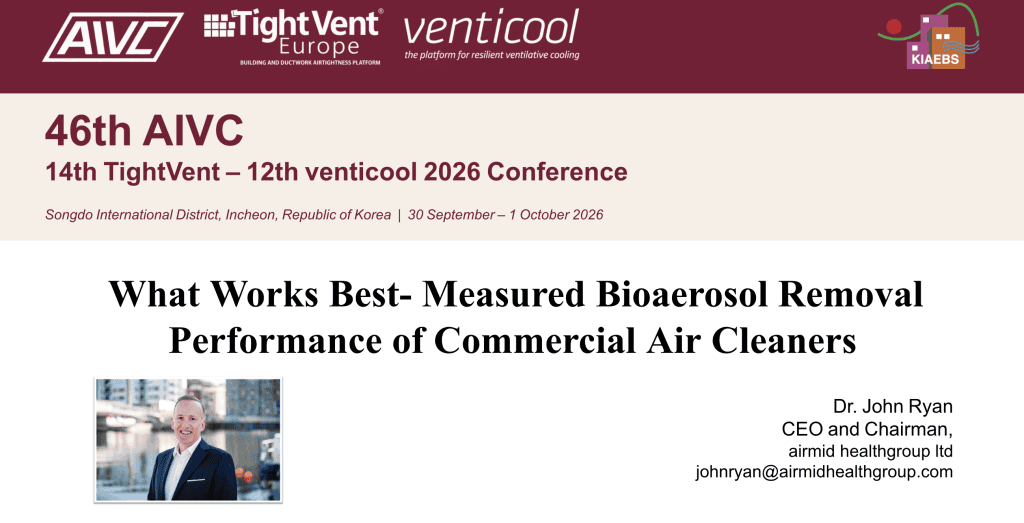
Dr. John Ryan of Airmid healthgroup presented new air cleaner testing research at the 46th AIVC, 14th TightVent and 12th venticool Conference. The conference was held from 30 September to 1 October 2026 at Songdo ConvensiA in the Songdo International District, Incheon, Republic of Korea. This year’s theme, “Innovations in Smart Ventilation and IEQ for Resilient and Adaptive Buildings,” brought together researchers, engineers and industry leaders from around the world to share the latest thinking on ventilation, airtightness and indoor environmental quality.
What Works Best: Air Cleaner Testing Under Controlled Conditions
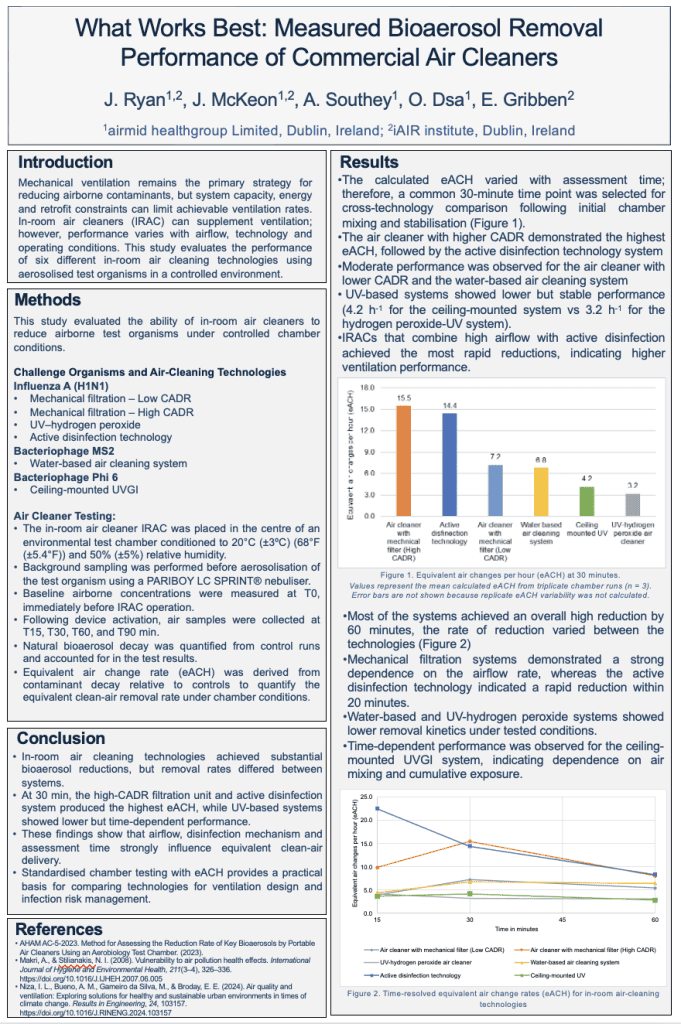
John presented “What Works Best: Measured Bioaerosol Removal Performance of Commercial Air Cleaners” as a short oral presentation with poster in the Smart Ventilation and IEQ session. The study was authored by J. Ryan, J. McKeon, A. Southey, O. Dsa and E. Gribben of Airmid healthgroup and the iAIR Institute.
Mechanical ventilation remains the primary strategy for reducing airborne contaminants. However, system capacity, energy use and retrofit constraints can limit how much ventilation a building can achieve. In-room air cleaners can supplement ventilation, but their performance varies with airflow, technology and operating conditions. That is where independent air cleaner testing comes in.
The team carried out air cleaner testing on six in-room technologies in a controlled environmental test chamber at Airmid healthgroup, using aerosolised test organisms. The technologies included mechanical filtration, UV-based systems, a water-based system and an active disinfection technology. Results were expressed as equivalent air changes per hour (eACH), which lets engineers compare air cleaners directly with the clean air delivered by ventilation.
All of the technologies achieved substantial bioaerosol reductions, but their removal rates differed considerably. Airflow, disinfection mechanism and assessment time all strongly influenced how much clean air each device delivered.
For a full resolution image or access to the study, please contact us.
Why Standardised Air Cleaner Testing Matters
Manufacturers often make performance claims under conditions that are hard to compare. Standardised air cleaner testing in a controlled chamber removes that uncertainty. It gives building engineers, specifiers and facility managers an objective basis for choosing technologies, planning ventilation strategies and managing infection risk.
The session was well attended, and the findings drew strong interest and discussion from delegates working at the intersection of ventilation design and indoor air quality.
Sharing Air Cleaner Testing Expertise with ASHRAE South Korea
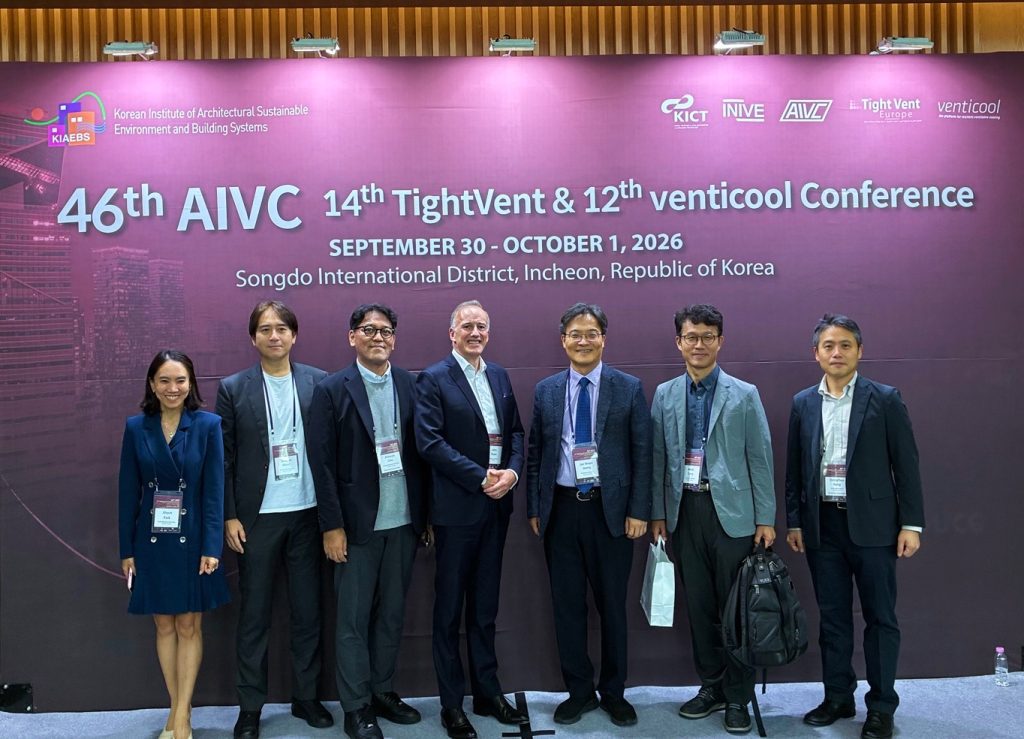
During the conference, John was delighted to meet several officers of the ASHRAE South Korea Chapter on behalf of ASHRAE Ireland.
Connections like these strengthen the exchange of knowledge between ASHRAE chapters. They also support shared goals around healthier, more resilient buildings, built on reliable air cleaner testing and evidence-based ventilation design.
Our thanks to KIAEBS, KICT and the AIVC, TightVent and venticool organising partners for a superb conference, and to our colleagues in Korea for their warm welcome.
Related Blog Posts
ASHRAE Standard 241: Control of Infectious Aerosols, Understanding Its Impact
How ASHRAE Standard 241 uses equivalent clean airflow to set targets for infectious aerosol control, and what it means for air cleaner manufacturers.
FAQ: ISO 15714:2019, Bioaerosol Efficacy Testing for Air Treatment Devices
What you need to know about the international standard for testing how well air treatment devices reduce airborne microorganisms.
FAQ on Environmental Test Chambers
Why controlled environmental test chambers are central to reliable air cleaner testing, and how they help industry bring better products to market.
Related Tests at Airmid healthgroup
Room Air Cleaner Testing
Independent testing of in-room air cleaners against viruses, bacteria, mould and allergens under controlled chamber conditions.
AHAM AC-5 Testing and Microbial CADR Certification
Testing to the AHAM AC-5 method for assessing how quickly portable air cleaners reduce key bioaerosols. This method was cited in the AIVC study.
ASHRAE 241 Standard Testing
Testing to establish the equivalent clean airflow delivered by air cleaning technologies, in line with ASHRAE Standard 241.

