
APIC 2025: Ultraviolet Comebacks, Air Purification Momentum, and the Certification Gap
APIC 2025 article By Dr. Matthew Hardwick, a leading expert in infection prevention and antimicrobial surface technologies, with a strong background in GLP studies and academic research that has advanced the field of infection control.
Key Innovations and Conversations from APIC 2025 in Phoenix

APIC 2025 took place June 16–18 in Phoenix, bringing together infection prevention professionals from around the world.
APIC is always a fun conference for me. I get to catch up with old friends and have numerous opportunities to meet new ones. This year’s conference was leaner than in the past. Of course, disinfectant manufacturers of all stripes made up the bulk of the show. However, it still showcased new things of great interest to the greater infection control and prevention community.
The Return of Germicidal Ultraviolet (GUV)

Airmid Healthgroup’s state-of-the-art aerobiology chamber supports rigorous testing of air cleaning and GUV technologies.
One of the most exciting developments this year was the strong resurgence of germicidal ultraviolet light (GUV).
Pre-COVID, we saw an increase in the number of GUV exhibitors, taking main stage alongside the big manufacturers. Post-COVID there was a dramatic drop in GUV presence. This year, however, GUV came back strong, exhibiting in key areas across the entire exhibit hall.
Conversations among practically all of the GUV exhibitors revolved around the FDA’s new “Whole Room Microbial Reduction Device” category of Class II medical devices. One thing is clear: GUV companies are either in the process of filing their 510k’s or are seriously considering doing so.
GUV manufacturers are coming from more diverse geographical regions than in previous years. US-based companies still predominate the APIC GUV space, however, new companies coming out of Canada and Europe are showcasing their products, as well.
There’s also been a wave of innovation. Over the last two decades, we’ve watched GUV evolve from low-pressure mercury and pulsed xenon bulbs to LEDs and novel wavelengths in both the near and far UV spectrum. This year, we saw artificial intelligence (AI) making a big splash in GUV. I am eager to see how this booming technology takes hold in newly engineered GUV devices.
Air Purification Takes a Bigger Breath
Another standout trend was the increased presence of air purification manufacturers. For years, air purifiers have had a modest but committed showing at APIC. This year, though, that footprint expanded noticeably. The big players were out in force, as expected, but I also spotted several new entrants to the healthcare infection control scene.
With the increasing interest in indoor air quality both in and out of healthcare, it is a welcome sight to see a boost in this space.
The Certification Conversation at APIC 2025
A recurring theme in my APIC conversations over the years has been a strong interest in certification programs. Companies want to attach a label to their products that indicates they meet some national or international standard. Of course, we see this type of certification for electrical safety, but we still don’t have anything for antimicrobial efficacy.
FDA clearance of label claims is certainly important, but most buyers don’t know what is behind the claims. That’s a real barrier to trust and adoption.
ANSI/HSI published a performance standard for GUV in ICUs and surgical suites, but it is new, and it is unclear how often it is being used. Now is the time to establish clear and informative performance standards that are straightforward for laboratories to perform, are not cost-prohibitive, and are useful to the consumer.
Final Thoughts on APIC 2025
As always, it was a pleasure to represent Airmid Healthgroup at APIC. We remain committed to supporting the infection control community with rigorous science, credible testing, and a mission to improve health outcomes in every built environment.
Word Tags
APIC 2025, Dr. Matthew Hardwick, Infection Prevention, Germicidal Ultraviolet, GUV, Indoor Air Quality, Medical Device Certification, Air Purification, Healthcare, APIC Conference, air cleaners
Related Resources

Reflections from the Irish Medtech Association AGM 2026
Learn how airborne infection control is becoming central to medical technology, with insights from Ireland's medtech community and industry leaders

IUVA Americas 2026 Recap: Germicidal UV Testing, Standards and Training in Focus
Highlights from IUVA Americas 2026 in Halifax: Airmid’s ASHRAE 185.1 germicidal UV testing presentation and key themes in GUV standards and training.
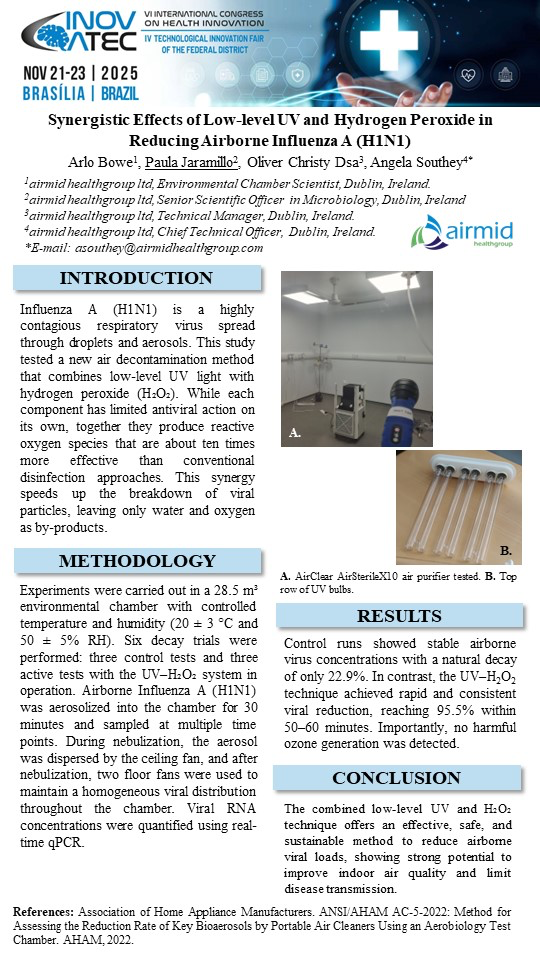
Exploring Combined UV and Hydrogen Peroxide for Airborne Virus Reduction
Research presented at INOVATEC 2025 explores how combined UV and hydrogen peroxide can reduce airborne Influenza A (H1N1) in controlled environments.

ASHRAE 241 Testing for Air Cleaning Systems
Request a quote for ASHRAE Standard 241 testing of your air cleaning system in Airmid Healthgroup's bioaerosol chambers in Dublin.
ASHRAE 241 Standard Testing Services for Control of Infectious Aerosols
ASHRAE 241 standard test lab for air cleaners, an ISO-compliant GLP enabled bioaerosol testing chamber for airborne pathogens & control of infectious…

ASTM E3273-21
ASTM E3273-21 Assess Microbial Decontamination of Air with an Aerobiology Chamber, for infectious aerosols, airborne pathogens & infection-control technologies.
Client case studies
View all case studies
Case Study: Air Sniper’s Germicidal UVGI Technology – Advancing Indoor Air Quality
Air Sniper collaborated with Airmid Healthgroup to scientifically validate the effectiveness of its germicidal UVGI technology in reducing airborne pathogens

APCO Air Purifier Validated by Airmid Healthgroup: Reduces Bacteria by 98.85% and Viruses by 99.03%
APCO Air Purifier, tested by Airmid Healthgroup, reduces bacteria by 98.85%, viruses by 99.03%, and VOCs, setting a new benchmark for indoor…

Fellowes AeraMax™ Air Purifiers – Validated for Healthier Indoor Air at the 2025 AHR Show
Validated by Airmid, Fellowes AeraMax™ air purifiers effectively capture airborne viruses and improve indoor air quality, as showcased at the 2025 AHR…
