
by Angela Southey PhD. and Tim Yeomans PhD. Airmid Health Group Ltd.,Trinity Enterprise Campus, Grand Canal Quay, Dublin 2, Ireland.
ABSTRACT
Health bodies and physicians advising on home allergen avoidance measures for asthmatics recommend removal of fitted carpets. Is this necessarily correct?
METHODS:
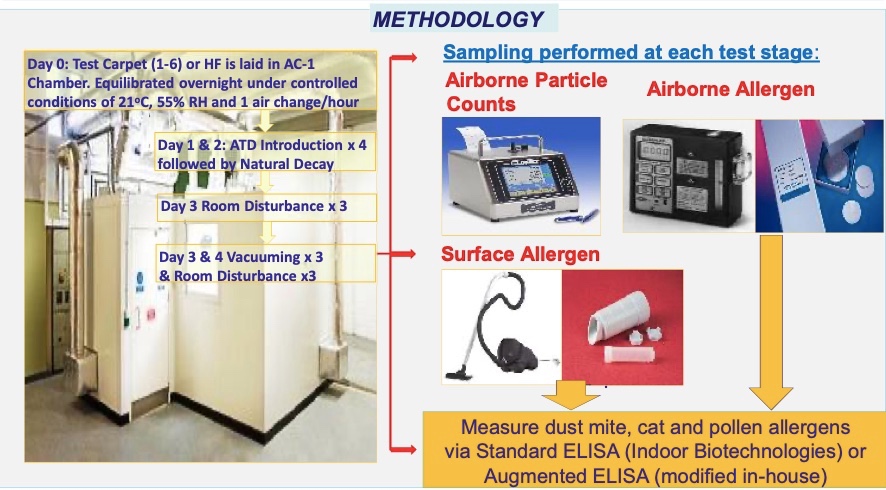
Allergen Test Dust (ATD) of known composition was aerosolised into an AC-1 (28.5m3) chamber under controlled conditions. During natural decay, room disturbance and vacuuming, serial airborne particle counts, surface and airborne allergen measurements (augmented ELISA), were undertaken for six different carpets and one hard floor.
RESULTS:
Following ATD introduction and during room disturbance the greatest airborne particle counts (x104/m3) were identified with the hard floor (1.0µm=157.4,>3.0µm=36.6), by comparison with (lowest) Carpet 3 (1.0µm=3.2; >3.0µm=0.50,p<0.01) and (highest) Carpet 2 (1.0µm=44.3; >3.0µm=4.5, p<0.05).
Airborne allergen (Derp1) measurements (pg/l) were also greater during roomdisturbance for the hard floor (74.7) than for Carpet 3 and 2 (55.5; 43.2).Vacuuming exaggerated these differences, hard floor (252.7) versus Carpet 3(55.5) and Carpet 2 (212.0). By contrast, surface allergen measurement(µg/m2) for the hard floor was reduced by vacuuming (14.4-0.16) while onlymoderately reduced for Carpet 3 (24.0-11.35) and Carpet 2 (22.5-8.33). Relevant particle counts and airborne allergen levels remained higher for the hard floor than for the carpeting post vacuuming. Repeated vacuuming resulted in reduced airborne particles for hard floor and Carpet 2, whereas Carpet 3 was low throughout.
CONCLUSION:
This study raises significant doubts about the assumed relationship between surface and airborne allergen levels. Some carpets act as a reservoir for allergen resulting in increased surface allergen levels, yet reduced airborne exposures during room disturbance. Are such carpets acceptable?
Methodology: Airborne exposures to allergen and particles with and without carpeting.

Summary: Airborne exposures to allergen and particles with and without carpeting
- This study indicates that different floor coverings have a significant impact on airborne exposure to allergens and these airborne contaminants were consistently lower for carpeting tested compared to the hard floor.
- A carpet’s pile height, density and fibre composition influences its particle retention capacity, according to Lewis et al, Causer et al. Carpet 3, a 100% nylon cut pile carpet, performed best during all test stages of this study, with the lowest levels of airborne allergen and particles detected.
- Foarde et al. detected lower airborne bio-pollutants in rooms with carpeting compared to hard floors in two schools in North Carolina. In parallel, he obtained higher concentrations of settled dust and allergens in rooms with carpets than with hard floors. This is reportedly due to the trapping and retention characteristics of carpets which keep contaminants and allergens out of the air (Foarde et al, Lewis et al).
- Similarly, we found that Carpet 2 and 3 acted as reservoirs for allergen, leading to increased surface allergen levels detected even after vacuuming. Airborne allergen and particle levels during room disturbance and during vacuuming were reduced for these carpets compared to the hard floor. In support of this, a review by Luedtke cites a number or studies showing that although carpets typically carry higher burdens of contaminants, they do not release significant levels into the air.
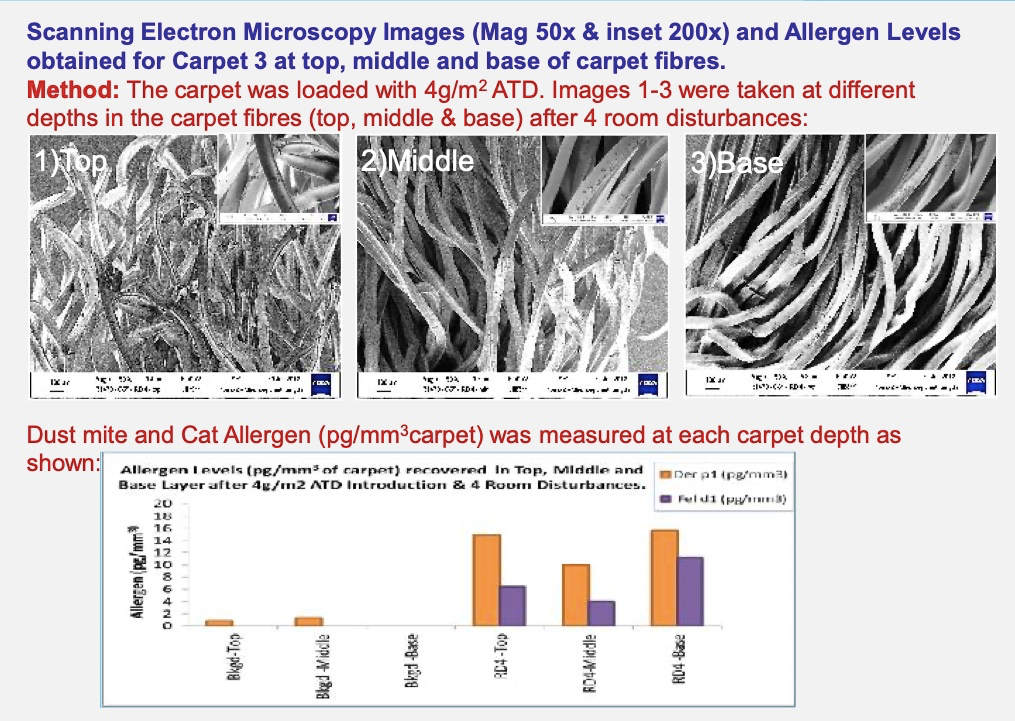
- The SEM images of Carpet 3, taken at 3 depths show the effect of room disturbance on the dust distribution (4g/m2) in the carpet fibres. Penetration of particles down to the base of the carpet was observed. The corresponding allergen graph shows that similar concentrations of dust mite and cat allergen were distributed between the top, middle and base of the carpet, following 4 consecutive room disturbances.
- This study raises doubts about the assumed relationship between surface and airborne allergen levels in rooms with carpets and therefore respiratory exposure.
References
Lewis RD, Breysse PN, Lees PS, Diener-West M, Hamilton RG, Eggleston P. Factors affecting the retention of dust mite allergen on carpet. Am Ind Hyg Assoc J. 1998;(59)(9):606-13.
Causer S, Shorter C, Sercombe J, effect of floor covering construction on content and vertical distribution of house dust mite allergen Derp1. Journal of Occupational and Environmental Hygiene, 2006; (3) 4: 161.
Foarde K, Berry M. Comparison of biocontaminant levels associated with hard vs. carpet floors in non-problem schools: results of a yearlong study. Journal of Exposure Analysis and Environmental Epidemiology, 2004;(14) S41.
Luedtke, AE. Floor covering, dust, and airborne contaminants. International E-Journal of Flooring Sciences. 2004; (1): 1-29. Sercombe, JK, Liu-Brennan, D, Causer, SM, Tovey, ER. The vertical distribution of house dust mite allergen incarpet and the effect of dry vacuum cleaning. Int. J. Hyg. Environ. Health, 2007; (210): 43-50.

